Catfishing, A Multi-Million Dollar Fraud Scheme

There are ways to tell if someone may be catfishing you. First, remember these are professional con men (and women) who will spend months cultivating a relationship. They also have researched their victims extensively before making contact. They know your likes and dislikes.
Fraudsters use photos of others to lure victims. One way to check this is by downloading their photo and doing an image search on google. Unfortunately, if someone looks too good to be true they probably are. It is important to remember that these scams are not limited to romance. Scammers will often impersonate sympathetic persons like deployed soldiers, the disabled, etc. in order to develop a relationship with you.
Many scammers will identify a target and pursue them relentlessly by sending flowers, love poetry, small gifts, etc. Scammers find targets on legitimate websites then try to convince the target to move their conversations to a messaging service like WhatsApp. Scammers do this because legitimate sites are good at detecting fraud but it typically takes a few weeks for the fraudster’s true nature to be discovered. Someone pressuring you to move quickly off the platform you meet is a huge red flag.
Scammers will usually tell you that their job sends them around the world. They talk regularly about arranging “physical” contact but it is always cancelled, usually at the last minute. Their social media usage is sparse. The cancelled meetings and lack of social media posts are usually explained by saying how busy they are. The fraudsters make up for their failure to meet you in person by sending menial gifts and saying they bought it for you while on their business trip. It is not uncommon for fraudsters to spend months cultivating a relationship with their target.
Once the victim is on the hook, the scammer will send a frantic communication about how they are in financial trouble overseas and promise to pay money back when they get back to the US. Some scammers will even pay back the money in order to set you up for the true scam. One example is a fraudster asking for $10,000 to pay a storage company to release needed equipment. The fraudster then returns the money within a few days. A couple weeks later, the fraudster will ask for more money or present a business investment opportunity that is really a scam.
Fraudsters also use catfishing to find people to help them with the fraud. They may ask you to set up a business name and business bank account for them. By doing this you may have committed money laundering by helping the fraudster possess or receive the criminal proceeds of their scams. At a minimum, opening a bank account for someone and receiving money on their behalf is a felony.
Many fraudsters are outside the United States. These criminals take advantage of people solely because it’s an easy way for them to steal money without having to rob a bank. These schemes evolve as technology changes so it is important to do what you can to protect yourself from these con men.

The Transformational Story of Pepper
 The Transformational Story of Pepper
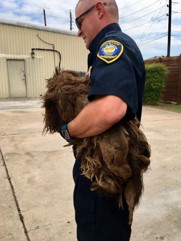
It was a Tuesday morning in early October when an Animal Cruelty Officer responded to a call in Acres Homes in Northwest Houston. A caller reported that an animal had been sitting out in the yard for months, with serious matting, and obvious sign of neglect. As the officer approached the house, he saw a small brown dog and three large dogs. It was obvious the small dog was severely neglected and in distress. Her hair was overgrown and matted in giant clumps all over her body, soaked in her own feces and urine, weighing her down. This dog was black, but her fur was bleached to almost white, evidence that she was sitting in her own urine. When asked about this case, Officer Farmer said, “I have been doing animal crime investigations for 11 years, and this was in the top 10% worst matting cases I’ve seen.”
Upon talking to the homeowner, the officer learned this dog was actually not the homeowners. A friend was moving to an apartment, and asked this friend to hold their dog while they moved. Unfortunately, they never returned for their dog and ignored calls and texts from the homeowner about getting their dog or why it was in this condition. It is confounding why people like the homeowner had this dog in their possession for months, but did nothing. “A lot of people put blinders on when they see something like this, but it is very important to call when you see any of these instances,” said Officer Farmer. “Any type of cruelty need to be reported so we can save these animals lives.” Later they would be fined and served a misdemeanor for cruelty to animals.
Shaky, afraid, and whimpering in pain, the dog was immediately seized by the officer and transported to Houston Humane Society to begin her health assessment and treatment. Upon arrival to Houston Humane Society, the veterinarian team assessed her health status and reported all signs of cruelty. She was very sensitive to touch and in pain with every movement due to the severe matting. She also tested positive for hookworm, heartworm, moderate dental disease, and a flea infestation.
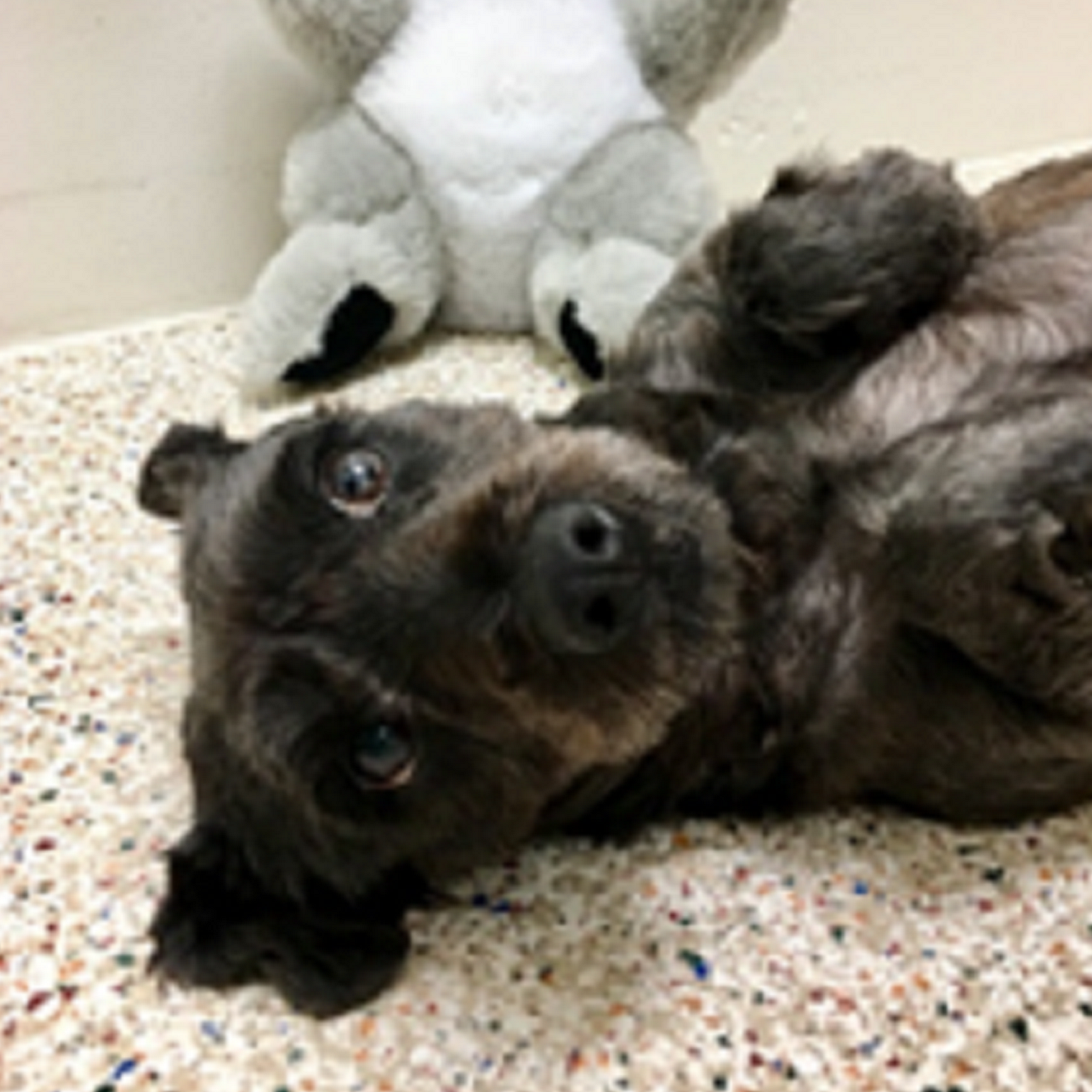
With their generous donation, a local groomer showed up at Houston Humane Society to give her a life-changing groom. When all her matted hair was removed, the pile of matted hair that laid beside her as big as she was. After what could have been a lifetime of neglect and pain, this new dog, affectionately named Pepper, was transformed to a spunky, sweet dog wanting nothing more than endless belly rubs.
When Houston Humane Society receives these animal cruelty cases, they are housed at the shelter for weeks. Owners must be held responsible at court, after which there is an additional 10 or more-day waiting period for the owner to appeal, depending on the county. Not only do animal shelters like Houston Humane Society help save these animals lives, they also house and rehabilitate all animals brought to them for care. Houston Humane Society relies solely on donations form the community, making each contribution so valuable to save these cruelty survivors and help them recover from trauma.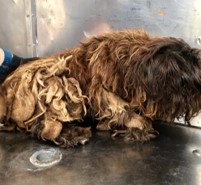
By the end of October, Pepper had gotten so much love and attention and all the staff and volunteers were excited and hopeful when she was put up for adoption. Just four days after being put up for adoption, Pepper found her forever home. A couple came in searching for a dog to add to their family. Upon meeting Pepper the bond was instant, Pepper had chosen her family.
This is their first family dog together, and they couldn’t be more thrilled about the addition to their home. “We were struggling with starting a family, and after a lot of challenges, Pepper has brought us hope,” her new owner shares, “Pepper brought us back to reality and is helping heal the pain and making a lot of changes. The house is more positive and warm. Taking care of someone else brings us joy. All our friend and family love Pepper as well.”
When asked about the importance of adopting survivors of animal cruelty and shelter animals, the owner said, “for any family looking for a pet, adoption is the better way to go versus buying from a breeder. Just like foster kids need a home, homeless animals need a home too. Adopting makes me feel a lot better and knowing my money is going to a good cause. I also liked how I was able to get all the information I needed for Pepper. It was a great experience because I knew what to do for Pepper. And it really saves a life.”
 Pepper was also heartworm positive, which required a $300-dollar treatment over the course of 3 months where the dog’s activity must be kept low. Many heartworm positive dogs have a harder time getting adopted, when asked about this, Peppers owner said, “I was discouraged at first about the heartworm treatment having an extra cost. I realized I could spend $300 dollars at Target or $300 saving a life and it was an easy answer for me. It is saving a life.”
It has almost been 3 months since Pepper was adopted, she is almost finished with her heartworm treatment, and she is living her best life. Her favorite thing to do is be around her humans. “She loves to be around people […] When it comes to people, her tail is wagging and she loves having companionship with people.” Like Pepper, there are so many great dogs out there. Do not turn a blind eye to dogs like Pepper. Report all cruelty. You can call 832-927-PAWS or online at 927PAWS.org and save a life.

Is Houston #1 in the Nation for Human Trafficking?

Houston repeatedly makes headlines for being known top human trafficking cities in the nation however what people do not often know is that we also make top lists for creating positive solutions to end sex trafficking.
You may have heard that Houston is #1 in the nation for sex trafficking. However, this statistic may or may not be true. There are many ways to measure the impact of an underground crime network in a city. You could count arrests, victim outcry, hotline calls, and online advertisements; just to name a few. Research and data are important, but I am no longer interested in where Houston ranks in this regard.
You may have heard on headlines that Houston is one of the main hubs for Human Trafficking. There are a lot of factors that give Houston its reputation for high volumes of human trafficking. But what you may not have heard is that Houston is one of the nation’s leaders in innovating solutions for ending human trafficking. After my 7 years of working with Elijah Rising, (an anti-human trafficking organization) I want to share three reasons why Houston is #1 in the nation for innovating solutions to end trafficking.
1. Houston is Strong
There is truly no place like Houston. Hurricane Harvey devastated entire regions of the city. The world was shocked as they witnessed armies of volunteers, boats, and builders emerge to lend a hand. Social Media became a 24/7 hotline of people offering rescue and aid to neighbors across the city. For months you felt a connected-grief, coupled with pride in this unbreakable city. Photos of families celebrating in flood-damaged homes while watching the world series began to circulate online.
Harvey was not the first time I encountered this side of Houston. I have worked with Elijah Rising fighting sex trafficking since 2013, and I have witnessed the unmeasurable generosity of this city. In 2015, our organization was blessed with 84 acres of land with homes that would serve as housing for those who have survived human trafficking. Unfortunately, the property and the homes needed extensive work done before they could be inhabited. Today, those homes are almost fully renovated and furnished. The property now has a new water well, septic systems, and even herb gardens. The majority of the work was done by men and women just like you, who lent a hand where they could or donated to pay for the work where it was needed.
2. Houston is Innovative
The city of Houston is extremely innovative and a leader in many fields such as the medical industry, energy, and ideas for social impact. Many of us in the nonprofit sector are seeing joint efforts in innovation for combating crime and human trafficking. Love People Not Pixels is a groundbreaking organization fighting demand by intervening with sex buyers. Oil and gas companies have banned together with OGTAG to ensure that their companies are leading the way in changing mindsets about Human Trafficking. Micah Gamboa, the Executive Director of Elijah Rising, created the Museum of Modern-day Slavery which highlights the history and reach of sex trafficking. I could go on, but trust me when I say that this city is not waiting for someone else to come and fix the issue. Which leads me to my final and most striking point.
3. Houston is Collaborative
One of the first things people notice about anti-trafficking efforts in Houston is how the work is being done by more than just law enforcement and nonprofits. In Houston, businesses, schools, community leaders, faith-based groups, even people in the printer industry are finding their place in the movement. And yes, I mean it when I say, printer salesmen! I can name three (Buy on Purpose, Neuralog, and DocumentWORKS). People from all walks of life and influence are linking arms to make sure that no person slips through the cracks. Nonprofits in Houston realize that not only can we work together, but there is enough funding to go around.
Collaborative networks like Houston 20 are using their voices in the nonprofit space to strategically fund new initiatives. Houston Rescue And Restore Coalition (HRRC) is an amazing collaborative of community members and nonprofits finding ways to cooperate and raise standards for best practices in anti-trafficking efforts throughout the city. Freedom Church Alliance is a collaborative of Christian churches focused on increasing volunteerism and awareness in Houston’s faith community. There so many more ways that people are taking a stand in this great city.
Human trafficking is a serious and complex issue, but it is not impossible to put an end to this injustice. Josephine Butler once said, “Immense as is the task before us, nothing shall ever shatter our faith. The justice of our cause is our surety of success” (The Voice of One Crying in the Wilderness, 1913).
I hope these words leave you encouraged and empowered to find your place in this great city to fight human trafficking.
How Can You help?
All of the organization names mentioned in this article are linked to their websites!
Get Educated!
Read information from trusted sources and those who have survived human trafficking to learn more about the issue.
Get Involved!
Volunteer with any of the organizations that are active in the city of Houston. There’s a place for you!
Get Invested!
Give to initiatives that fight sex trafficking.
The Sad Facts About Teen Dating Violence

Do you remember jumping off the monkey bars and a parent or teacher telling you to stop before you get hurt? But then you ignored them and continued to jump anyway. And before you knew it, all it took was one wrong landing and your arm is broken moments later. You find yourself laying there wondering how you are going to tell the very same people who told you to stop, that you need help; fear of being shamed, or embarrassed. But there they are to pick you back up and take you to get a cast, comforting you while you wait, putting aside the frustration that they told you to quit jumping and just assuming that you’ll learn your lesson for next time.
As I tell this to the students who I am presenting to that day, they chuckle as they remember the time the were in this situation. The smiles turn to sadness as I then continue with, “that’s what it can feel like to the teens who are dealing with teen dating violence.” As I look around the room, faces turn red and others make eye contact with each other. Either they know someone dealing with it, or they are going through it themselves. 75% of Texas 16-24-year-olds have either experienced dating violence or know another young person who has.
I always ask them what they think of when they hear the word violence, or abuse. They don’t hesitate to say fighting, hitting, kicking, punching, etc. This is why it is hard for teens and others to recognize the signs of dating violence, because there’s a blurred idea that it is only physical. Teen dating violence is defined as the physical, psychological, emotional or sexual violence within a dating relationship, including stalking. It can occur in person or electronically and can occur between a current or former dating partner.
Teens vicariously live through technology, where connections, relationships and friendship or no longer exclusively in person. They can talk to whoever they want at any time, any place. But, because of this:
- Nearly 1.5 million high school students nationwide experience physical abuse from a dating partner in a single year.
- Victims of digital abuse and harassment are 2 times as likely to be physically abused, 2.5 times as likely to be psychologically abused, and 5 times as likely to be sexually coerced.
- 1 in 4 dating teens is abused or harassed online or through texts by their partners
- 1 in 5 victims say they experienced digital abuse or harassment at school and during school hours (most takes place away from school grounds).
Have you been concerned for someone’s well-being and noticed changes? Those changes could be a result of being a victim of dating violence. The National Domestic Violence Hotline listed signs as a checklist to bring awareness of what this can look like to outsiders:
- Their partner puts them down in front of other people
- They are constantly worried about making their partner angry
- They make excuses for their partner’s behavior
- Their partner is extremely jealous or possessive
- They have unexplained marks or injuries
- They’ve stopped spending time with friends and family
- They are depressed or anxious, or you notice changes in their personality
According to Love is Respect, “82% of parents feel confident that they could recognize the signs if their child was experiencing dating abuse, a majority of parents (58%) could not correctly identify all the warning signs of abuse.”
The question I often get from teens is, “why don’t they just leave?” While it can seem like there is a common sense answer; for those who are battling dating violence, there is no “easy” way out. They are being guilted into thinking it is their fault, they are terrified of the repercussions of leaving, being judged, not being believed, having a false idea of abuse being love, belief that dating violence is acceptable due to violence in the home or past experiences, etc.
Students are not equipped to deal with dating abuse – 57% say it is difficult to identify, and 58% say they don’t know how to help someone who’s experiencing it.
A few healthy things friends/family can assist a fellow classmate or friend with, according to the National Domestic Violence Hotline is to:
- Acknowledge that they are in a very difficult and scary situation, be supportive and listen
- Be non-judgmental
- Help them develop a safety plan
- Encourage them to talk to people who can provide help and guidance
- Remember that you cannot ‘rescue’ them
As a parent or guardian of the teen, also remember to:
- Accept what your child is telling you, listen and be supportive. Even when you don’t understand or agree with their decisions, try not to judge them. It can make them feel worse.
- Allow them to make up their own mind. Leaving an unhealthy or abusive relationship may be difficult and even dangerous. Avoid blaming or belittling comments. Abusive partners usually put down their victims regularly, so your loved one’s self-esteem may already be low.
- Even though helping can be frustrating, don’t give up. More than anything, they need to know they can trust you and rely on you.
- Don’t prevent them from seeing their abusive partner. This can cause them to feel as if they need to keep secrets from you, as well as feel as if decision-making is being taken away from them.
12/4/19: Fox 26 Isiah Carey Factor – Be aware of fake sex trafficking warnings spread on social media
Viral posts warning of the red flags of sex trafficking spread across social media like wildfire, but many aren’t true.
Crime Stoppers CEO Rania Mankarious joins other sex trafficking activists on FOX 26 Houston Isiah Carey FOX 26 to discuss important things you should know about the human trafficking warnings you might have seen circulating on social media. Please take a moment to watch and share.