Sunday Mornings with Rania: Alissa Parker’s Story
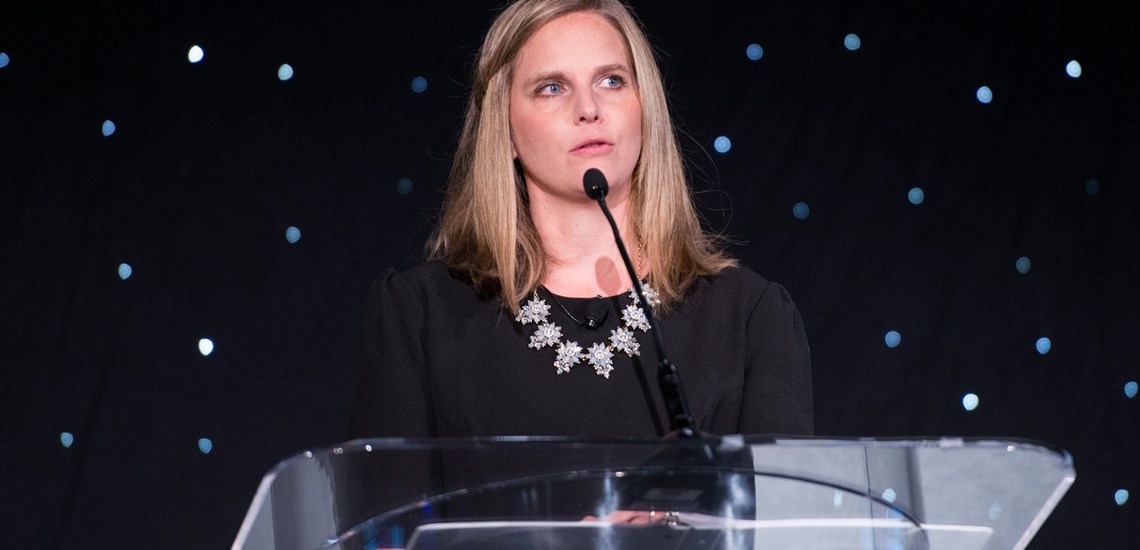
I know what people think when we first meet and I tell them what I do . . . Crime Stoppers? . . . You work there? followed by a slightly awkward pause in which I can tell they’re thinking What on earth? Why? What does Crime Stoppers even do? I find myself in and awkwardly making my way through those conversations often. And while I’m not overly concerned by what people think and I’m certainly not embarrassed by what I do, there is a certain sense of dread every time I go through this.
But then I met Alissa Parker, mom of Emilie Parker, one of the 20 first graders killed in the Sandy Hook Elementary School mass shooting and my goodness did she put it all into perspective for me.
It was this past Thursday and she was in town for the Crime Stoppers of Houston Gala. We met early in the morning at KRBE where she and I were doing an interview with Roula Christie, Ryan Chase, Producer Eric and the entire team at The Roula and Ryan Show. We met in the lobby. She greeted me with a smile and a type of joy that almost seemed foreign to me. I did my best to compose myself but ultimately burst into tears the second I opened my mouth to greet her. As I apologized, she, almost comforting me, said not to, that it was how most people responded to her at the first encounter.
We spent the entire day together and talked at length about that dreaded day in December of 2012. She shared that she had dropped her daughter off at the bus stop, how Emilie always turned around to wave goodbye from the window but that morning, for the very first time and for whatever reason, did not. About how Alissa got started on her to-do list with the number one item being buying Christmas gifts for her girls (Emilie was the oldest of three). She was at the store when she got the notice about a school shooting.
Racing to Sandy Hook, she shared the impossibilities of getting there, parking there, navigating the firetrucks, reporters, frantic parents, police and caution tape. Not allowed in the school, families waiting to reconnect with their children were placed in a holding room at the fire station. About five and a half hours later, an elected official walked in and, unaware that the families had not received any updates up until that point, shared that their precious sons and daughters had “expired” due to the shooting. That was the word that was used according to Alissa. Expired.
My heart just wanted to burst.
Alissa shared more details about that awful day including how she and Emilie spent that morning together to how Emilie, who loved to do fashion shows, changed outfits many times for her mom as she excitedly got ready for school. She ultimately chose pink everything – a pink bottom and top. Emilie made it a point to draw Alissa’s attention to the flowers on her wall, adamant that her mom see the connections between the various colors. Alissa, not making eye-contact at this point, explained how much she loved and cherished those daily hours with Emilie, how that time was their time before the younger two girls woke up but how now, Emilie’s final words about “connections” were carrying Alissa forward each and every day.
I hung onto every word Alissa said. After all, we pour so much into our children. We love them with all we have. From their little hands that we hold to the little shoelaces we tie, to their little jackets we button up – we love our kids and cherish watching them grow and go through the journey and phases of life. We invest in them, we dream for them, we strive to give them everything we possibly can. We send them to school to color, to read, to write, to sing, to learn, to dance, to be challenged, to socialize… And while they are there, my goodness, their lives should never be at risk, especially children, little, tiny children.
The reality is, there should have never been the tragedy of Emilie Parker. There shouldn’t be mourning moms like Alissa Parker. There shouldn’t have been a mentally ill boy like Adam Lanza that had gone for so long with no help or treatment. Crime Stoppers’ Safe School program recognizes all that and for years has offered a solution. Alissa didn’t give me an awkward look when we met. She didn’t question what we do or why we do it. Rather, as a grieving mom, she thanked us for working on a solution. And we are offering a solution. To date, the Crime Stoppers Safe School Program has reached one million Houston kids and has solved nearly 2,000 school cases and removed almost 300 weapons from schools before they could be used against students. If we have saved just one life (and we know we have saved many) then it is worth its weight in gold.
So ask me my name and what I do . . . I’ll share what it is with deep conviction. I’m the Executive Director of Crime Stoppers of Houston and we are in the business of keeping you and your families and your animals safe. That’s our mission and we carry it proudly.
Sunday Mornings with Rania: Runaways or Lured Away?

We all followed the details of the recently missing Memorial High School student. Thank goodness this beautiful 15-year-old from a lovely family is back with her family. While the details of her story are not reflected in this writing, the bigger questions stemming for her and any child’s disappearance are: Where do kids go when they leave? How does this happen? Do they really run away? Why?
Runaways. Some toss “running away” to a simple point in a child’s life when they need a break or time to do their own thing. In order to run, a child must have the willingness, opportunity and ability. Psychologists also identify triggers like stress, failure, bullying, fear of discipline, a desire to exert power, dealing with a substance abuse, not wanting to go to school or even idealizing running away (creating a romanticized view of freedom in life on the streets) as factors that lead kids to go. While runaways face grave dangers, if they are in control of their fate, the thinking is they will return.
Lured away. But what if the child ran away because they were strategically lured away? There is a huge distinction. A child who is lured away has unknowingly been in contact with a predator who has targeted them, invested in them and at the moment they run, sees them as a financial commodity where they will be held against their will and forced to do the unimaginable. Sure, these children may willingly walk out of their homes but they have been defrauded and will more than likely be trafficked. I would say the dangers for these kids are grave, making it critical that the community come together, in full force, to find them.
Before you think that can never happen here, think again. In January 2017, a study by the Institute on Domestic Violence & Sexual Assault at the University of Texas at Austin School of Social Work reported that there are more than 313,000 victims of human trafficking in Texas, including almost 80,0000 minors and youth victims of sex trafficking cases. Further study shows that while victims of human trafficking were traditionally thought to be homeless individuals, children and youths in the foster care system, and migrant workers, times are changing and so are the victims.
Today we are learning that traffickers are placing recruiters in churches and schools, in all parts of our city, to find their targets. To learn more about this, I spoke to Jennifer Hohman, with Community Awareness Now (CAN). Data on their website spells out the process by which the everyday child, in a regular neighborhood, in a great home, could fall into this trap.
The child is:
- Befriended – recruiters are strategically placed in the child’s life to befriend them and gain their trust. They can be new kids at school or church. They may look like your child and will fit right in.
- Intoxicated – once the friendship blossoms, the recruiter introduces alcohol or drugs to start the process of breaking the child down and creating a wedge between the child and her family. Now the child has secrets that she shares with the recruiter but keeps from you. She starts to “enjoy” things that make her feel older and more independent.
- Alienated – now that a wedge is developed, parents start responding to the changes in their child by placing more rules and in turn the recruiter uses this to drive a greater wedge between the child and her family.
- Isolated – in addition to causing friction at home, the recruiter drives distance between the child and her friends and introduces the child to a new crowd of people.
- Desensitized – by this time, the child has heard so much about “life could be so much better if they were just free.” Parents and their rules are a burden, the child has already done drugs or been drinking, they may have started sleeping with a boyfriend/girlfriend or shared promiscuous images online. They start to see traditional thoughts about respecting themselves and their families as immature and no longer pertinent.
- Capitalized – at this point, the recruiter has convinced your child that life is better somewhere else and a plan is placed for your child to leave home. Once away from you, the trafficking starts and the retrieval of this child goes down to 1 or 2 percent.
It’s important to realize that by the time you reach step 6, your child “willingly” runs away but the real issue is your child was never truly in control of this decision and the outcome. Their immaturity and the parents’ naivety all work to the predator’s advantage.
But we can all stop being naive. We can know the signs, know who your child is talking to, question everyone, and invest in your ability to protect the child and her ability to protect herself. Share stories with your young children about the risks of running away and how predators lure children away and why. A lot of this is achieved through simple education and awareness. Talk to your kids. Talk to other family members. Talk to your school and do whatever possible to protect your children and all children. Every one of these children is worth the thought and conversation.
Sunday Mornings with Rania: Reflections on Las Vegas


I had less than 15 minutes to grab something from Tootsies. But while there, my dear friend, Shelley Taylor Ludwick (their media and events manager) stopped me. Before even saying hi, she put her hands to her face and uttered just two words, two words that were now filled with meaning beyond measure, two words that were jam packed with questions, two words that required hours of conversation, study and follow up, two simple words: Las Vegas.
Between our silent expressions and sadness, we still communicated so much: How? Why? And the surviving families? Our hearts were shattered… And what is the real story with the shooter? We want so desperately to put him in a category, to try and understand his motive (Religious? Political? Hate speech? Mental illness? Workplace violence? Family violence?)… My goodness, such a tragic loss of life couldn’t have happened “just because…” And in light of all the details, what on earth is next?
And, of course, what does this mean for us and all the plans we have in the days and weekends to come? Many of us are planning to attend any number of the historic festivals here and across the state starting this weekend; we have concerts to go to, playoff games to attend, exhibits to see and life to enjoy.
But how will it all work, now, post Vegas? The Austin City Limits Festival is offering refunds to any ticket purchaser who is uncomfortable following the mass shooting in Vegas. So do we go? Not go? How do we navigate this new world and what do we tell our kids? Here are my 10 tips to get us through this awful time.
- Go. Go, go and by all means, GO! And have the best time!
- Know and follow the rules. There are safety measures at every venue. Know the rules. Follow them. Don’t be that person that argues at the door. We need our security personnel focused on identifying danger, not wasting time arguing with guests.
- What’s the plan? Talk, talk, talk about what’s going on in the world as well as the potential of what could go wrong while you are out and about. Then create a plan with the group you are going out with. If an emergency were to erupt, what door will you exit from? If the threat is near you, will you fight and what tools are around you to use? Are you near a waste basket, a speaker or a chair? Is there something on you that you can throw? How many entrances and exits are in the venue and what’s the nearest one to your group? Identify all of this and have a plan in case the unthinkable happens. You don’t want those moments of panic to be the first time you think of your survival.
- If you get separated… In the chaos, try to stick together but you may get separated. Decide beforehand where a meeting point will be. Have option A, B and C.
- Cell phones. Always have your cell phone. Go out with a charged phone or bring a portable charger with you.
- Have a designated outside point of contact. To preserve battery life and to limit noise that draws attention to you, have one designated family member or friend assigned to call you should news of a tragedy break (the worst thing is to have to navigate a life and death situation when your phone is ringing off the hook).
- There’s an app for that. Make sure you have identification on you as well as information on your medical health. And guess what, your phones are already equipped to do this. For iPhone users, this technology appears through the Health App and is accessible even in the phone’s local screen. Androids have the same function but you must download the medical ID app. These medical apps keep a list of your allergies, medicines, contact information and is of critical importance to first responders or any other time you are being treated in a time of emergency.
- Talk to kids. It’s critical to include your kids in on your safety plan. Here’s how I’ve handled this in the past. Let’s say we are at the movies, I tell my kids in advance – we are totally safe and I can’t wait to see the movie, that said, it’s always good to be prepared so if a fire breaks out or an accident happens in the movie theater and we need to leave quickly, we are going to exit that door right there. Now, we may need to go fast and leave our popcorn or blankie or toys behind. Don’t argue with mommy about this and trust me when I say we can come back later and get you popcorn and I will restore any item you’ve lost. When dealing with older kids, kids who may be of age to attend a concert or large festival with other friends – make sure you talk to them beforehand about potential risks and that they have personally followed tips 1-7 above. If you’re hesitant to tell them what could go wrong because you think you’ll scare them or they are not mature enough to handle the information, then they are absolutely too young to go without parent supervision.
- Focus on survival, not video footage. I am always amazed at how many people stop to take video during a disaster. On one hand, I understand it and I know many are thankful to get a real glimpse of what went on but, on the other hand, I think it’s extremely dangerous and takes your attention off survival. Be careful before you take out that phone…
- See something, say something. We say this all the time but I don’t think people really stop and think about what this means. If you are committed to saying something if you see it then you are probably committed to paying more attention than normal at your surroundings. This is wonderful. We want people to always go out and have fun but we also want you to be carefully examining your surroundings at all times, taking note of strange people or events. Be prepared to say something if you must. Your life and the lives of others could depend on it.
I’m not going to say that active shooters are a part of our lives now but I will say that if the thought never even crosses your mind when you are out and about, you are doing yourself a disservice. Your survival depends on your ability to think clearly, quickly and strategically. Trust me when I say the best way to accomplish this is with a plan.
Whatever your next few days and weeks hold, the shooting in Las Vegas grows father away in time but not in significance. We will never forget and together, my hope is that we can work to eradicate this type of horrifying activity. For all our sakes.
Sunday Mornings with Rania: The Elderly Driver We Know
We all saw the headlines last week: 79-year-old in custody after officer critically injured on Southwest Freeway and we all immediately asked the same questions – was the driver drunk? Was the victim, 24-year-old Houston police officer, Nestor Garcia, critically injured?
Story lines continued to run and, as a community, we prayed for Officer Garcia who was not just hit but tragically dragged. Out of surgery, he is recovering from a head injury, abdominal injuries and fractures. I know all of our thoughts continue to be with this young officer and his family.
But what about the driver? What’s the story behind the wheel? Was he drunk? Was he on medication? Was it simply age? Vision? Or was it something else? And what about his family? Were they worried about him driving? Did they try to stop him from taking the wheel? Who is liable when you have an elderly driver behind the wheel and tragedy strikes? Could he be sentenced? Serve time in jail?
To begin, it’s important to note that this is a significant issue. According to the Insurance Institute for Highway Safety, there were 22 million licensed drivers aged 70 and older as of 2008, representing 78 percent of that demographic group. According to the CDC, in 2015, there were more than 40 million licensed drivers ages 65 and older in the United States (an increase of almost 50 percent). Generally, driving helps older adults stay mobile and independent. Certainly though, the risk of being injured or killed in a motor vehicle crash increases as you age.
What does the state say?
Let’s start by talking numbers – 79 is a key one. According to the Department of Motor Vehicles and the Texas Transportation Code, in addition to the regular driver license renewal requirements, individuals 79 years of age or older must meet extra requirements to renew their license:
- Individuals aged 79 – 84 must always renew in person every six years. All individuals 79 or older must always take a vision test.
- Individuals 85 or older must always renew in person on the driver’s second birthday after the previous expiration date; fees are reduced.
And what about the family? Are you ever liable for an accident at the hands of your elderly parent?
- What if you provide financial support for your aging parent – does that attach liability? No: even if you pay for their home and car, you are not liable. The exception can be found, however, if the car is registered in your name.
- What if you should have stopped your elderly family member from driving but didn’t or couldn’t? According to the law, you are still not legally obligated to control your parent’s driving, especially when they are driving their own or someone else’s vehicle.
- What if you let your aging parent drive your car? Here is where liability attaches. If you let your aging parent drive your car – meaning any car registered, leased, or rented to you – when you know that his/her driving abilities are diminished or that he/she’s not properly licensed, you may be liable for damages caused in an accident.
- What if you have power of attorney? In this case, you absolutely can be and more than likely will be liable for any and all judgments above your elderly parents auto coverage. You may find yourself paying out of your own pocket for the defense and any judgment rendered against you for your negligent failure to act (i.e., stop your parent from driving).
How to play it safe when it comes to the elderly drivers in your family:
- Talk to them with respect and trust but with honesty
- Remind them to limit driving in bad weather, at night and on high-speed roads
- Ask them to plan routes before they leave and not rely on navigation to get from point A to point B
- Go over what medications are being taken and their possible side effects
- Remind older drivers that whether due to age, weight loss or medications, their response to alcohol will not be what it used to be
- Focus on good health and exercising regularly to increase strength and flexibility
- When in doubt, there is nothing wrong with asking for a ride from friends or family or using a ride-sharing platform like Uber
Life’s transitions are difficult, especially for aging individuals. It is also difficult for the families. But in all things, through talking and planning, tragedies can be mitigated. The consequences of not handling these situations head-on can be tragic. We saw this this last week when it hit home, in our Houston community. We continue to pray for Officer Garcia as well as both families on both sides of this tragic scenario.
Sunday Mornings With Rania: The Road to Recovery
It rained last week. And it was kind of a big deal.
As I sat in my office at Crime Stoppers of Houston and watched the clouds go from light to dark with sheets of water falling over the city skyline, I couldn’t help but sense the tightening of my back and the quickening of my heart. Living in Houston, it rains often but this rain, this hard, foggy, post-Harvey rain . . . rain that led to “area flooding” alerts . . . had an unexpected effect on me.
But it wasn’t just me.
My phone pinged as tweet after tweet indicated others were feeling the same way. I stopped to think of the phenomenon of emotion taking place in offices around the city, from those in high-rises to mid-rises to strip malls; from school teachers, to house moms to business executives; rich or poor, young or old, black, white or other – I think what at the beginning of the summer may have been an unnoticeable hard “shower” was now, post-Harvey, causing many of us to stop in our tracks and survey for potential risks and dangers.
There has been a shift in our thinking but it makes sense. Harvey came in like a slow, consistent, persistent and unwanted terror. He lingered and his rains tormented six million Houstonians without discrimination. Together, we flooded, we were afraid, we suffered loss, we cried, we were uncertain, we saw the images but we loved, we hugged, we gave, we carried, we rose…
All that said, as we move forward, can we take a moment to shine the light on what might be brewing in the back of all our minds? According to Medscape, the very real emotional responses to a disaster develop in four phases and almost all of us go through them:
- Impact phase (first week) – we are left feeling stunned, in disbelief, numb, afraid, and confused
- Crisis phase – following impact, we go between denial, fatigue, headaches, nausea, to anger, irritability, apathy, or even social withdrawal; we may become angry with those who we deemed responsible to have prevented or fixed the disaster
- Resolution phase – guilt, acceptance, grief, coping
- Reconstruction phase – reassignment of meaning and reintegration into a new self-concept occur
These stages are normal yet not finite. The versions you experienced may vary. The point is, you have, I have, we all have recently gone through some version of these four phases (many of us are still in “resolution” and “reconstruction”. It helps to know, allow and respond accordingly. Not just internally but when dealing with others.
Beyond that, for a smaller percentage of people, the effects will be more significant. In fact, the American Psychiatric Association places “natural disasters” in the list of both acute stress disorder and post-traumatic stress disorder (PTSD) triggers. While acute distress disorder usually occurs hand-in-hand with whatever traumatic event is being experienced, PTSD tends to show up approximately 30 days later. Ask yourself if you are experiencing any of the following:
depression, anxiety, panic disorder, fear generally or fear of the unknown, flashbacks, nightmares, avoidance of situations that bring back the trauma, strong physical reactions when reminded of the event, including heart pounding, trouble breathing, sweating and insomnia.
According to Asim Shah, M.D., chief of the Division of Community Psychiatry at Baylor College of Medicine and leader of an effort to provide mental health services for Harvey evacuees: the sudden and overwhelming nature of natural disasters can leave many shocked, emotional, and uncertain about their future – conditions ripe for the development of PTSD.
Don’t be afraid to get help.
Whether for yourself or your children, don’t feel afraid to get help. Help will vary based on you and your symptoms but can range from journaling your feelings to talking about them with a friend or a professional. The point is, recognize them, name your feelings (I feel afraid; I am angry…) and then tackle why you are feeling this way and create a plan to get past it. You will get past it. We all will.
We will remain the strong city we have come to be known for but that requires us taking care of more than our roads, homes, parks and street. We need to take care of our health, wellness (physical, emotional and mental) and, of course, our safety. Together. If any city in American can do this, it’s Houston.